IDStewardship

  • Home
  • Articles
  • LEARN ANTIBIOTICS
  • Study Guide
  • Resources
  • Q&A
  • #ASPchat
  • Contributors
  • About

Fosfomycin (Monurol, Contepo)

Fosfomycin

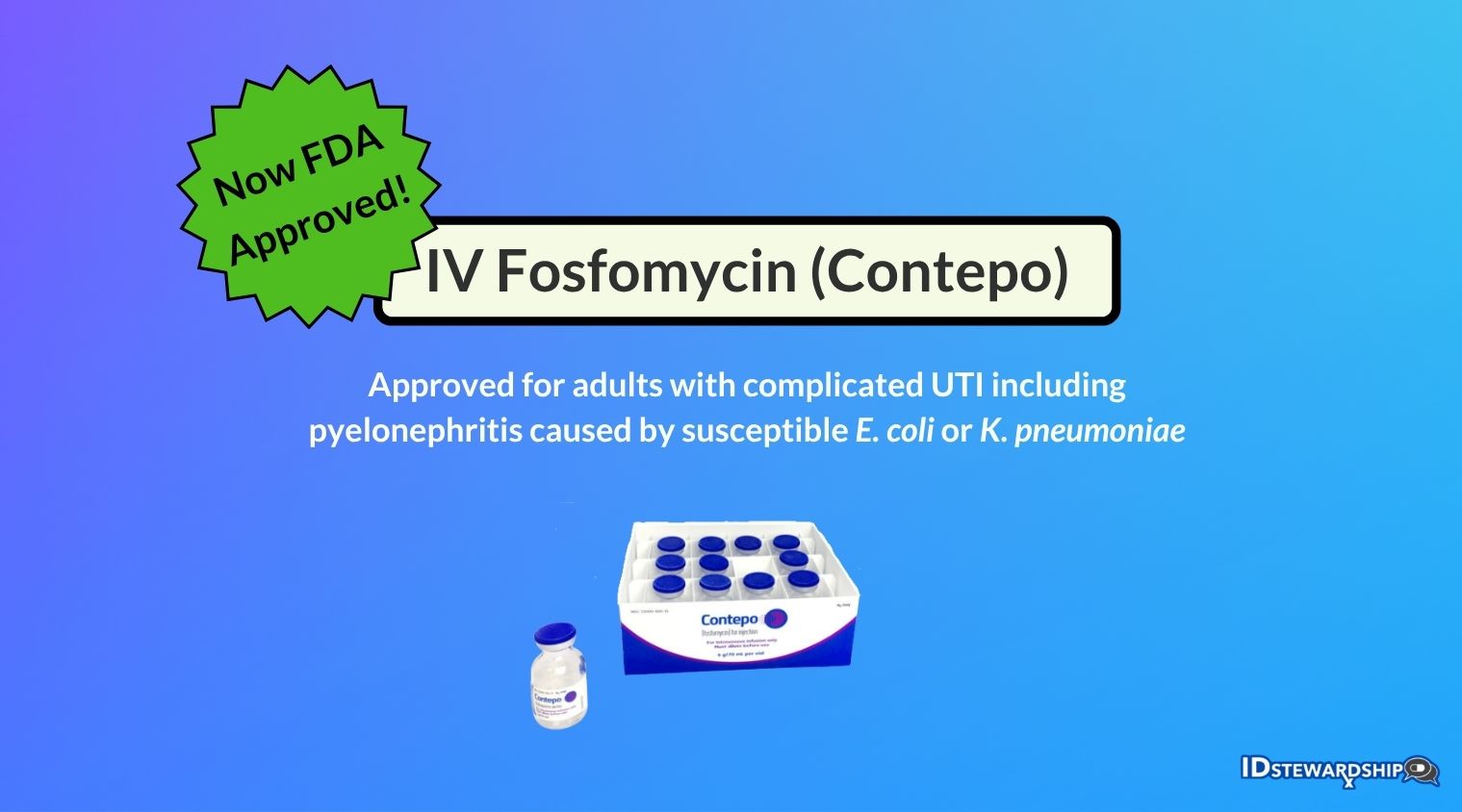
Fosfomycin IV

Contepo photo source: CliniExpert

KEY POINTS

  • Fosfomycin (Monurol [oral], Contepo [IV], Fomicyt [IV]) is an epoxide antibacterial drug that works against susceptible bacteria by inactivating pyruvyl transferase (an enzyme critical for cell wall synthesis), which results in interference with bacterial cell wall formation
    • The ratio of unbound plasma fosfomycin AUC to MIC of the bacteria correlates with activity
  • Fosfomycin may be an important option for treating infections caused by drug-resistant bacteria
  • Many microbiology labs do not routinely perform fosfomycin susceptibility testing
    • Fosfomycin has activity versus a wide variety of bacteria, including MRSA, Pseudomonas aeruginosa, Acinetobacter baumannii, E. coli, Klebsiella pneumoniae. However, not all bacteria are included in the FDA approved indications.
    • Has activity versus some carbapenemase and extended spectrum beta-lactamase producing organisms
    • While fosfomycin resistance has been observed, cross-resistance between fosfomycin and other antibiotic classes has not been seen
  • Oral fosfomycin (Monurol) has been FDA-approved since the 1990s, intravenous fosfomycin (Contepo) was FDA-approved October 22nd, 2025

Oral Fosfomycin (Monurol)

  • Oral fosfomycin comes as granules in a packet called a sachet, which is mixed with cool water before oral ingestion
    • Oral bioavailability is reduced 30% in under-fed conditions, giving with a high-fat meal may enhance absorption, but the label says may be taken with or without food
    • It is excreted as unchanged drug into the urine (38% of dose) and feces (18% of dose)
    • Renal dysfunction reduces fosfomycin elimination into the urine, although the label does not recommend any renal or hepatic dose adjustments
  • Oral fosfomycin is only FDA-approved for uncomplicated UTI in adult women, for which a single 3 gram dose can cure the infection. E. coli and E. faecalis are the two bacteria included in this approval.
    • Oral fosfomycin has been used off-label for complicated UTI and prostatitis. For off-label uses, the dosing interval is usually once every 48 or 72 hour and durations of treatment can vary.
  • Some of the more common side effects reported include diarrhea, headache, and vaginitis
  • Oral fosfomycin is somewhat expensive compared to other UTI agents, although prices have come down in recent years. Other agents with recent FDA approvals for cystitis include gepotidacin, sulopenem, and pivmecillinam.

IV Fosfomycin (Contepo, manufactured by Meitheal Pharmaceuticals)

  • IV fosfomycin has been available outside the US for many years, including as Fosmicyt pictured above
  • FDA approval is for complicated UTI including pyelonephritis in adults with infections caused by susceptible isolates of E. coli or K. pneumoniae
  • Dose is 6 gm IV Q8H infused over one hour, for a duration of 14 days
    • Comes as 6 grams per vial as a dry powder that must be reconstituted
    • 70% of the dose is excreted in the urine unchanged in 12 hours and up to 80% in 48 hours
    • Adjust dose and/or frequency for renal function when eCrCl is below 50 mL/min or less
  • Holds warnings for:
    • Serum electrolyte abnormalities – the high sodium amount in the vial (1980 mg Na per vial) may contribute to elevated sodium or reduced potassium, calcium, or phosphorus. Due to the sodium content, the infusion solution for dilution is sterile water for injection (stable for 16hrs at room temp).
    • QT prolongation – Baseline with periodic monitoring may be indicated
    • Increased transaminase levels – AST/ALT should be monitored
    • Neutropenia including agranulocytosis – CBC should be monitored
    • Hypersensitivity reaction (also has a contraindication if known serious allergy)
    • C diff associated diarrhea (CDAD)
  • Labels says to advise females not to breastfeed during treatment and for 24 hours after the final dose

RESOURCES

  • IV fosfomycin Package Insert
  • Oral fosfomycin Package Insert
  • IDSA Practice Guidelines
  • Fosfomycin Review Article (2016)
  • FDA Expanded Access (Compassionate Use)
  • Fosfomycin for the treatment of patients with bacterial prostatitis: a systematic review (2015)
  • Rediscovering the value of fosfomycin trometamol in the era of antimicrobial resistance: A systematic review and expert opinion (IJAA 2023)
  • Effectiveness of Fosfomycin for the Treatment of Multidrug-Resistant Escherichia coli Bacteremic Urinary Tract Infections (JAMA 2022)


Free Antibiotic Cheat Sheet

Study Guide

  • Pharmacotherapy Study Guide
  • Acyclovir (Zovirax)
  • Albendazole (Albenza)
  • Amikacin
  • Aminoglycosides
  • Amphotericin B (Fungizone, Abelcet, Ambisome)
  • Amoxicillin (Amoxil)
  • Amoxicillin-Clavulanic Acid (Augmentin)
  • Ampicillin
  • Ampicillin-sulbactam (Unasyn)
  • Anidulafungin (Eraxis)
  • Artesunate
  • Atovaquone (Mepron)
  • Azithromycin (Zithromax, Zmax)
  • Aztreonam (Azactam, Cayston)
  • Aztreonam-avibactam (Emblaveo)
  • Bacitracin
  • Baloxavir marboxyl (Xofluza)
  • Bamlanivimab
  • Baricitinib (Olumiant)
  • Bebtelovimab
  • Bezlotoxumab (Zinplava)
  • Brincidofovir (Tembexa)
  • Cantharidin (Ycanth)
  • Casirivimab and Imdevimab (REGEN-COV)
  • Caspofungin (Cancidas)
  • Cefazolin (Ancef)
  • Cefepime (Maxipime)
  • Cefepime-enmetazobactam (Exblifep)
  • Cefepime-Taniborbactam
  • Cefiderocol (Fetroja)
  • Ceftaroline (Teflaro)
  • Ceftazidime (Fortaz, Tazicef)
  • Ceftazidime-avibactam (Avycaz)
  • Ceftobiprole medocaril (Zevtera)
  • Ceftolozane-Tazobactam (Zerbaxa)
  • Ceftriaxone (Rocephin)
  • Cefoxitin (Mefoxin)
  • Cephalexin (Keflex)
  • Cidofovir (Vistide)
  • Ciprofloxacin (Cipro)
  • Clarithromycin (Biaxin)
  • Clindamycin (Cleocin)
  • Colistin (colistimethate)
  • Cycloserine (Seromycin)
  • Dalbavancin (Dalvance)
  • Daptomycin (Cubicin)
  • Delafloxacin (Baxdela)
  • Dicloxacillin
  • Doripenem (Doribax)
  • Doxycycline (Doryx)
  • Elbasvir/ grazoprevir (Zepatier)
  • Eravacycline (Xerava)
  • Ertapenem (Invanz)
  • Erythromycin
  • Famciclovir (Famvir)
  • Fecal Microbiota Spores, Live-brpk (Vowst, SER-109)
  • Fidaxomicin (Dificid)
  • Fluconazole (Diflucan)
  • Flucytosine (Ancobon)
  • Foscarnet (Foscavir)
  • Fosfomycin (Monurol, Contepo)
  • Ganciclovir (Cytovene)
  • Gentamicin (Garamycin)
  • Gepotidacin (Blujepa)
  • Glecaprevir/ Pibrentasvir (Mavyret)
  • Ibrexafungerp (Brexafemme)
  • Imipenem-cilastatin (Primaxin)
  • Imipenem-cilastatin-relebactam (Recarbrio)
  • Isavuconazole (Cresemba)
  • Itraconazole (Sporanox)
  • Ivermectin (Stromectol)
  • Ledipasvir/sofosbuvir (Harvoni)
  • Lefamulin (Xenleta)
  • Letermovir (Prevymis)
  • Levofloxacin (Levaquin)
  • Linezolid (Zyvox)
  • Maribavir (Livtencity)
  • Meropenem (Merrem)
  • Meropenem-vaborbactam (Vabomere)
  • Metronidazole (Flagyl)
  • Methenamine (Hiprex, Urex)
  • Micafungin (Mycamine)
  • Minocycline (Minocin)
  • Molnupiravir (Lagevrio)
  • Moxifloxacin (Avelox)
  • Nafcillin
  • Nitrofurantoin (Macrobid, Macrodantin)
  • Omadacycline (Nuzyra)
  • Oritavancin (Orbactiv, Kimyrsa)
  • Oseltamivir (Tamiflu)
  • Oteseconazole (Vivjoa)
  • Oxacillin
  • Nirmatrelvir/ ritonavir (Paxlovid)
  • Penicillin
  • Penicillin Skin Test
  • Phenazopyridine (AZO)
  • Piperacillin-tazobactam (Zosyn)
  • Pivmecillinam (Pivya)
  • Plazomicin (Zemdri)
  • Polymyxin B
  • Posaconazole (Noxafil)
  • Quinupristin-dalfopristin (Synercid)
  • Remdesivir (Veklury)
  • Rezafungin (Rezzayo)
  • Ribavirin
  • Rifabutin (Mycobutin)
  • Rifampin (Rifadin)
  • Secnidazole (Solosec)
  • Sofosbuvir/ velpatasvir/ voxilaprevir (Vosevi)
  • Sulopenem etzadroxil and Probenecid (Orlynvah)
  • Sotrovimab (Xevudy)
  • Sulbactam-durlobactam (Xacduro)
  • Sulfadiazine
  • Sulfamethoxazole-Trimethoprim (Bactrim)
  • Tecovirimat (TPOXX)
  • Tedizolid (Sivextro)
  • Telavancin (Vibativ)
  • Tigecycline (Tygacil)
  • Tobramycin
  • Tocilizumab (Actemra)
  • Valacyclovir (Valtrex)
  • Valganciclovir (Valcyte)
  • Vancomycin
  • Voriconazole (VFend)
  • Zidovudine (Retrovir)
  • Zoliflodacin (Nuzolvence)
  • Zoster vaccine recombinant, adjuvanted (Shingrix)

Recent

  • IDstewardship Year End Review 2025
  • 5 Practical Tips for Pharmacists to Improve Acute Uncomplicated Cystitis Management
  • Year in Review: Top Infectious Diseases Journal Articles From 2025
  • Antimicrobial Stewardship In Pakistan: A Pharmacist’s Perspective
  • 5 Survival Tips For Clinical Pharmacists: Advice From A Senior Antimicrobial Stewardship Pharmacist

Search

Copyright 2016-2026 By Charlie Rose, LLC &COPY · IDStewardship.com · Copyright · Privacy Policy · Terms · Contact