AI-Generated Summary: In this reflection from the first SIDP x MAD-ID “Antimicrobials” meeting, practical pearls are shared for antimicrobial stewardship pharmacists ranging from communication strategies to evolving perspectives on clinical practice and professional growth. The piece highlights how conferences can spark new ideas, reinforce stewardship principles, and provide valuable networking and educational opportunities for pharmacists working in infectious diseases.
Authored By: Timothy P. Gauthier, Pharm.D., BCPS, BCIDP
Article Posted 17 May 2026
In 2026, Making A Difference in Infectious Diseases (MAD-ID) and the Society of Infectious Diseases Pharmacists (SIDP) joined their annual meetings for the first time. This is a big deal for the infectious diseases communityl. Huge congratulations are due to the event organizers. This event serves as what I would assume is the largest annual gathering of infectious diseases pharmacists worldwide. They reported 755 meeting attendees in 2026, which is impressive but even more impressive is the opportunity to be here and interact with so many passionate people with shared interests.
During the opening, it was announced that the meeting will be named “Antimicrobials” which as Dr. McCreary humorously acknowledged, is much easier to say than all of the words in MAD-ID and SIDP. Using the hashtag, I noticed the Australian Society for Antimicrobials has a meeting called Antimicrobials, so I’m not sure if the name will stick, but time will tell. MAD-ID has been in Orlando for years but now, with the evolution to ‘Antimicrobials’, it is going to be moving cities each year, with the 2027 meeting taking place in Baltimore, MD from May 22nd to 26th which is slightly later than this year but still before Memorial Day.
Antimicrobials and ESCMID Global are my two favorite meetings of the year, followed by IDweek. There is just so much to learn and so many people to learn from. The experience is a 10/10 and the vibes are high. As usual, during the meeting I picked up several tidbits that I plan to try to incorporate into my practice, research, or general approach to life. I thought these pearls were worth sharing. Here are a few pearls from the 2026 Antimicrobials meeting in Orlando, FL, I hope you find them helpful!
1. Quests and simple gaming strategies can be used to level-up my antimicrobial stewardship education dissemination game
Disseminating antimicrobial stewardship education is never easy. In a session hosted by Dr. Jeffres several simple ideas were shared that I could see being very easy and practical to use for boosting engagement and reach.
One idea was to do a low-stakes scavenger hunt with a simple incentive (e.g., a Learn Antibiotics book), to have folks find specific resources you want them to know about for their practice. Adding in a competition element with a prize can boost interest. Labeling it as a ‘quest’ instead of a game, having people work together, and giving positive feedback (i.e., fluffing them up) to encourage people to lean into the activity were great suggestions.
Including a QR code at the end of an activity to do a simple survey seems very doable and measuring website traffic may be a low-hanging-fruit opportunity for gathering some data.
One specific game I want to call out is this true/false node matrix that you use to solve a word puzzle. Create a list of true/false questions. Start at the first node. Go up if the answer is true, go down if the answer is false. Use the correct path to find the correct word. You can use this matrix or develop one on your own. This tool from free dictionary may be helpful to find words that start with or end with specific letters.
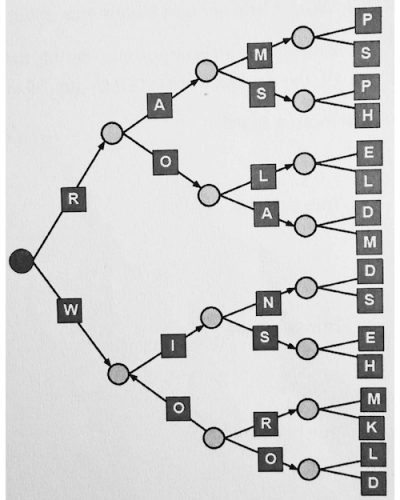
Image credit: Dr. Meghan Jeffres
2. Carbon emissions and other waste information can easily be estimated using a free online Antibiotic Waste Calculator
Sustainability is something I expect to get more attention as time goes on so an opportunity to learn about it was welcomed. Dr. Pallotta provided an array of helpful information but one item I thought was neat was a simple online waste calculator. It allows you to compare two or more regimens to see what the amount of plastic waste is. It allows you to estimate the environmental impact of stewardship interventions over time.
The webpage offers a Plastic Waste Calculator, which will give you plastic waste per dose in grams if you enter the antibiotic, dose, route, frequency, form, and duration. For example, a dose of cefazolin 1 gram IV from a duplex produces 63 grams of plastic waste.
They also offer an Environmental Impact Calculator, which will give emissions information if you enter the antibiotic, dose, route, frequency, disposal method (landfill or incinerate), and duration. For example, a dose of locally compounded cefazolin 1 gram produces 2.920e-6 t CO2 equivalent emissions and 0.0003 kg of coal burned.
Consider – how much waste is your projects diverting from the landfill?
3. Developing quick reference cards via a badge buddy may be a neat way to level-up your nursing stewardship engagement
One of the posters caught my eye because it was about involving nurses in antimicrobial stewardship, a topic I am always curious to learn more about. The project was by Dr. AlQaryan and Dr. Marfatia from Tufts Medicine MelroseWakefield Hospital and associated with Massachusetts College of Pharmacy and Health Science. I can’t go into detail because I don’t want to violate conference policies, but I can share they had a ~6 x 4 inch photo on the poster of a quick reference simple handout titled “UTI Quick-Check for Nurses”. This was printed and used as a badge buddy for nurses. It included content of:
- Are there true symptoms?
- Are there supporting labs?
- For catheterized patients
- Do not treat if
A major challenge with nursing stewardship is that there are often many nurses to engage and reaching them all 1-on-1 may not be feasible. Another challenge is that nurses are very busy and focused on immediate patient care needs, so stopping them to review an 8.5×11 document is often too much to ask. I really like this straightforward messaging and highly accessible dissemination approach.
4. Reference ‘The Last of Us‘ show to get people’s attention when talking about fungal infections
As humans we often quickly categorize topics as relevant or irrelevant and then that impacts our level of engagement in it. Management of fungal infections certainly is a topic that may suffer from being perceived as less relevant, so having ways to capture the target audience’s attention can be helpful.
If you are not familiar with The Last of Us, it was a show on HBO about a post-apocalyptic world where a fungal infection (Cordyceps) turns humans into zombie-like creatures and society struggles to survive. It effectively stirs an emotional response about the threat of fungal pathogens to human health.
While it does need to be a balanced approach, leveraging this pop culture reference may generate interest for your next fungal stewardship initiative. One speaker indicated that the show directly contributed to getting project funding. A speaker who was a patient treated for a fungal infection also mentioned the show. Clearly it is an attention grabber.
5. When a rapid diagnostic blood test detects a CTX-M negative E. coli and a patient is critically ill and at risk for a bad outcome, continuing piperacillin-tazobactam ‘because they are sick’ may not make sense
Dr. McCreary and Dr. Doern delivered a delightful yet complicated talk discussing ESBLs and MICs. This is one point they emphasized and acknowledged the emotional component of antibiotic decision making. How continuing the course may feel like the best option when the data say otherwise.
CTX-M-negative isolates can still potentially demonstrate piperacillin-tazobactam resistance. In the study quoted during the talk the rate of piperacillin-tazobactam resistance was 5.3% in CTX-M negative Klebsiella pneumoniae, E. coli, and Proteus mirabilis.
In turn when a physician declines the offer to de-escalate from piperacillin-tazobactam to ceftriaxone even though CTX-M was not detected and the rationale is ‘because the patient is too sick’, it actually makes more sense to escalate to meropenem. Luckily if you are the ID pharmacist having this discussion, you will be primed to also talk about rational merospenem use.
Another parallel discussion I appreciated was how SHV and TEM infrequently travel alone, so even if CTX-M is not detected, it’s unlikely a SHV or TEM would be there. SHV and TEM often coexist with additional other resistance mechanisms. Dr. Doern additionally endorsed that ceftriaxone non-susceptibility is a reasonable marker for the majority of ESBLs in the United States.
A last tidbit from this talk was how piperacillin-tazobactam minimum inhibitory concentrations change based on inoculum, which is discussed here. It never ceases to amaze me how complex clinical microbiology is.
Bonus Tidbits
- The paper ‘The Sorting Hat of Medicine: Why Hufflepuffs Wear Stethoscopes and Slytherins Carry Scalpels’ was mentioned by one of the lecturers, which was pretty interesting. It looked at picking medical specialties based your Hogwarts house affiliation.
- In casual conversation with some senior colleagues about conference abstracts going into journals (e.g., IDweek abstracts going into Open Forum Infectious Disease), it was mentioned the PMID and DOI can be critically valuable since they are credible sources in research and grants. This means having abstracts published formally matters for whether or not someone may be able to send their work to a given meeting. Maybe you knew this, I did not. I thought it was interesting.
- Olorifim is an antifungal drug Dr. Thompson from UC Davis shared insights on. He mentioned it’s likely to come to FDA approval in 2027 (time will tell). He mentioned that it could have a paradoxical effect which I had not heard about yet, which is discussed in this paper.
- Genetic testing can be done which provides insights for ototoxicity from aminoglycosides (e.g., the MT-RNR1 gene) or voriconazole toxicity. I have not come by many practical uses for genetic tests in the realm of antimicrobials but Dr. Mark Gilchrist shared these tidbits with me. More information is available via the genetic testing registry.
- Lastly, I learned about the writing pad called Remarkable, which looks like an iPad mixed with a kindle reader. It is a digital paper tablet designed for distraction-free handwriting, note-taking, reading, and annotating documents with a paper-like writing experience.
Did you like this post? Share it with a friend!
DISCLAIMER: The views and opinions in this article represent those of the author and may not reflect the policy or position of any previous, current, or potential future employer. ChatGPT has been used to enhance readability and identify helpful resources.
RECOMMENDED TO YOU