AI-Generated Summary: Scientific poster sessions are valuable for sharing early research, but many presenters receive little engagement despite significant time and cost invested in preparing their work. The article argues that social media—particularly short-form video—offers an underused opportunity to amplify poster content, extend its reach beyond the conference floor, and enhance knowledge dissemination when done thoughtfully and with proper consent.

Authored By: Timothy P. Gauthier, Pharm.D., BCIDP
Article posted: 26 April 2026
Have you ever presented a poster at a scientific conference? How many people stopped to engage with your work—and how did it go?
After attending many conferences, I’ve come to value poster sessions as one of the most dynamic parts of the experience. They offer a unique window into emerging ideas, foster informal discussion, and often spark new research directions.
Yet there’s a disconnect.
Poster presenters invest substantial time and energy preparing abstracts, designing visuals, and traveling—often at significant personal and financial cost. Despite this, the return on that investment can be unpredictable. Some posters attract steady engagement, with a dozen or more meaningful conversations. Others receive little to no attention. At certain meetings, engagement is so sparse that facilitators are assigned simply to ensure presenters aren’t left standing alone.
The Visibility Gap
At the ESCMID Global 2026 conference, I had the opportunity to serve as a social media ambassador alongside three colleagues. Our role was to amplify conference content across platforms. Traditionally, this amplification has centered on X (formerly Twitter), though there is a growing shift toward Bluesky.
However, most social media content highlights large, formal presentations—keynote talks, plenary sessions, and major reviews. Poster sessions, despite their density of novel ideas, are largely absent from the digital conversation.
This raises a simple question: Can we do better?
A Simple Model for Poster Amplification
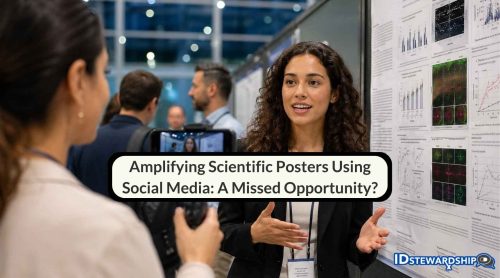
To explore this, I piloted a lightweight approach to sharing poster content via short-form video. The process is straightforward and scalable. A tripod stand and microphone was used to support production quality.
1. Ensure voluntary participation: Presenters must be comfortable appearing on camera and sharing their work on social media. Participation should always be optional.
2. Set clear expectations: A host briefly introduces the topic, then invites the presenter to introduce themselves and deliver a concise, ~30-second summary of their work or key message. Brevity is critical—it aligns with social media algorithms and keeps content digestible.
3. Record efficiently: Short-form video tools (e.g., TikTok) are ideal. Features like countdown timers, pause/resume recording, and flexible framing allow for quick, polished clips without requiring a single perfect take.
4. Add captions: Captions improve accessibility and engagement, especially for viewers watching without sound—and they’re favored by platform algorithms.
5. Confirm consent: Before posting, presenters should review and approve the final video. For larger-scale efforts, formal consent processes may be warranted. Conference organizers may also need to approve any sharing of poster content.
6. Distribute widely: Post across multiple platforms to maximize reach and shareability.
Early Results
At ESCMID Global, I created five videos using this approach. Most featured colleagues I already knew, though one team enthusiastically volunteered. Collectively, these videos generated 47,000 impressions in a 1-week period.
- Eravacycline for bacteremia
- Antibiotic shortages
- Premixed daptomycin
- Stewardship tools (ESGAP project)
- Antibiotics and dentists
While my existing social media presence contributed to that reach, the contrast is striking: the visibility achieved through these short videos far exceeded what the posters would have garnered on their own.
Looking Ahead
Scientific conferences are rich with early-stage ideas that often remain confined to physical poster halls. Social media offers a powerful, underutilized channel to extend their reach—connecting presenters with broader audiences, fostering collaboration, and accelerating knowledge dissemination.
There is clear opportunity for innovation here. With thoughtful implementation—grounded in consent, accessibility, and respect for conference policies—future meetings could pilot structured initiatives to amplify poster content at scale.
The challenge is not whether the tools exist. It’s whether we choose to use them.
Disclaimer: The views and opinions expressed in this article are those of the author and do not necessarily reflect the policies or positions of any past, present, or future employer. ChatGPT was utilized to enhance clarity and formatting.
RECOMMENDED TO YOU