AI-Generated Summary: Antimicrobial stewardship and environmental sustainability are closely connected, as responsible antimicrobial use helps reduce pharmaceutical pollution, limit the spread of antimicrobial resistance, and protect ecosystems while maintaining high-quality patient care. This article highlights four practical ways healthcare professionals can integrate environmental considerations into stewardship efforts without compromising the effectiveness or safety of antimicrobial therapy.

Authored By: Andrea Pallotta, PharmD, BCIDP, AAHIVP
Article Posted 1 August 2026
Antimicrobials are one of the most prescribed medications in the world. While life-saving, medications production, packaging, and end-of-life disposal contributes to greenhouse gas (GHG) emissions associated with the healthcare sector. This article will summarize key terminology in the healthcare sustainability space and ways antimicrobial stewardship and pharmacy can minimize the impact.
1. Understanding greenhouse gas emissions and the healthcare sector:
Greenhouse gases (GHGs) are atmospheric gases that drive temperature increase on Earth. These include methane, nitrous oxide, hydrofluorocarbons, carbon dioxide, and others and are often referred to in their carbon dioxide equivalent (CO2e). CO2e is a unit to standardize emissions from different GHGs based on global warming potential. GHGs from emissions, waste disposal, and plastic production lead to air pollution and increased global temperatures. The increase in temperature leads to shifts in weather patterns such as higher rates of wildfires, hurricanes, and floods. These weather events, such as wildfires and the decreased air quality, can have a negative impact on human health, particularly for vulnerable populations with cardiovascular or pulmonary disease, elderly, and young children.
Extreme weather events and a warming planet impact microbiology and vectors of transmission. Warming ocean temperatures and salination can alter bacterial growth. Urbanization and forest loss lead to fragmented habitats for vectors and more human-animal contact. Mosquito0 and tick-borne illnesses such as malaria and lyme disease are found in new areas.
But there is hope! Healthcare professionals have an opportunity to impact the judicious use of medications, to decrease waste and improve healthcare delivery. First, let’s talk about the scopes of GHG emissions across the value chain and where pharmacists can have the most impact.
SCOPE 1: Direct emissions from the company or entity (i.e., emissions from company owned vehicles)
SCOPE 2: Indirect emissions from the use and generation of energy for the company or entity (i.e., the emissions associated with keeping the lights on)
SCOPE 3: EVERYTHING else – these are emissions associated with the delivery of services and includes the disposal of waste generated during daily operations, investments, and use of products, among others.
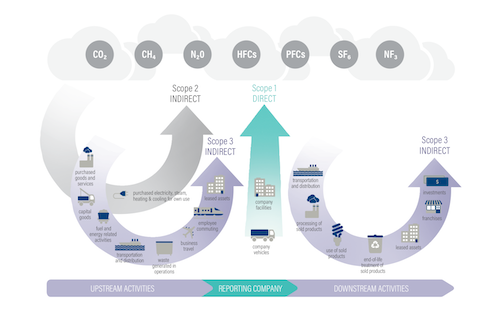
Image used with permission, attribution to wri.org
Antimicrobial stewards have the greatest opportunity to reduce scope 3 emissions in the healthcare sector. This is where plastic comes in. Plastics are created from fossil fuels and production of plastic accounts for 3.4% of global GHG emissions. Plastics amount to about one-fourth of the waste produced by the healthcare sector equivalent to 3,500 tons of plastic waste PER DAY in the United States.
Plastic is in the overwrap of many medications, surgical instruments, gloves, masks, gowns, and tools used for medication and healthcare service delivery. Plastic waste degrades slowly, and generally by breaking down into smaller and smaller pieces until it becomes a microplastic; a particle less than 5 millimeters in size that can enter the body through inhalation or ingestion.
Literature on the negative health impacts of microplastics is ramping up. Researchers from Italy found that there is an association with carotid artery plaque and microplastics. Patients with microplastics in their plaques had a 4.5 times higher rate of composite stroke, myocardial infarction, and death. A study out of New Mexico examined post-mortum brain tissue of patients with and without dementia. The patients with dementia had higher levels of microplastics in their brain tissue compared to those without dementia (26,076 ug g-1 vs 4,131ug g-1).
Plastic reduction not only saves waste and the environment, it can improve health too.
2. It’s time for action – Playbook for Integrating Environmental Sustainability Into Hospital Pharmacies
A great place to start to assess how well your hospital pharmacy sustainability stacks up is with the CASCADES Playbook for Integrating Environmental Sustainability Into Hospital Pharmacies. CASCADES “catalyzes climate action in healthcare by collaborating with Canada’s healthcare community to deliver high-quality, low-carbon, sustainable, climate-resilient care.”
CASCADES offers a free online tool with a checklist of activities pharmacies can take to mitigate waste and risk and adapt to the new climate. Environmental sustainability is baked into antimicrobial stewardship. The CASCADES scorecard specifically highlights antimicrobial stewardship programs in the “Clinical Activities” section due to the impact these programs can have to optimize medications to avoid unnecessary use.
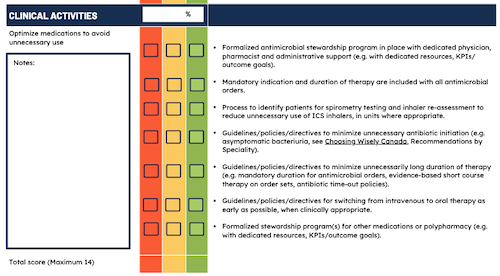
Scorecard: Sustainable Hospital Pharmacy Scorecard. CASCADES; 2025 [accessed 4 August 2026]. Available here.
This scorecard is a great place to start when discussing environmental sustainability to pharmacy leadership. Now, let’s get into action!
3. Waste calculators: where to start?
As antimicrobial stewards, we are always elbows deep in data. These tools can help add a sustainability outcome to your initiatives and projects without much effort! Your job is to pick which outcome you want to calculate.
Solid Waste Calculations:
The EcoRxChoice.com antimicrobial plastic waste calculator developed by Pam Lee, Hugh Gordon, and Gary Fong is a great place to start. The team has done the hard work to calculate the amount of plastic required to compound and administer standard antimicrobial doses in a hospital setting. You select the antibiotic, dose, administration method (IV/PO), form, frequency, and duration. The tool calculates the plastic waste per dose and total waste if using for more than 1 dose.
You can compare the plastic waste of different products to find the difference in waste and calculate waste saved by an initiative. For example, you have an antimicrobial stewardship project aimed at reducing long durations of therapy for community acquired pneumonia. Looking at pre and post intervention groups, you can calculate the plastic waste for all doses and subtract the post-group from the pre-group for a sustainability focused secondary endpoint!
(PS you can add cost savings too to really turn the heads of your leadership team!)
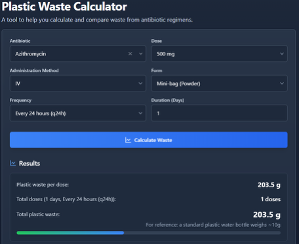
The above image is from EcoRxChoice and you can find learn more about their methodology in this publication.
Hand calculated methods at your location site are also another method. If your manuscripts include waste calculations like this, be sure to include how you measured the waste in the methods section.
- For example, you have an initiative to change from compounded oral vancomycin suspension to capsules. You want to calculate the overall waste saved.
- Option 1: calculate the empty weight of the cup/lid or oral syringe/cap for the compounded product and subtract the empty weight of the capsule unit dose pack
- Option 2: To account for the waste created during the compounding step, you can include the (weight of the vancomycin vials and caps + flavor agent bottle + sterile water bottle) divided by the number of doses per recipe, and add that to the weight of the delivery device (cup/lid or oral syringe/cap)
- Example:
- Weight of empty vancomycin vials and caps: 200 gm
- Weight of empty flavor agent bottle: 20 gm
- Weight of empty sterile water bottle: 30 gm
- Total: 250 gm for 50 doses = 5 gm per dose (compounding waste generated)
- Add the 5 gm to the weight of an empty cup (2 gm) = 7 gm per dose, 28 gm per day (4 doses per day)
- Example:
The weight really starts to add up as you expand to weeks, months, quarters, and years! All of the waste associated with drug administration usually ends up in the trash! What you might not know is that hospitals pay for trash removal (out of sight, out of mind) and many times, the hospital is charged based on weight of the trash. Waste reduction initiatives will also save money on bills to the waste management company and landfill!
GHG emissions or CO2e saved
Calculating emissions associated with the production and waste disposal of antimicrobial doses is another way to show benefit.
Two tools are available:
- EcoRxChoice – EcoRxChoice has a handy “Environmental Impact Calculator” that will calculate the CO2e per dose and day of therapy based on how the product is disposed of (ie landfill or incineration). Incineration, although safe and effective at reducing medication waterway and environmental contamination, requires high amounts of energy and creates emissions. (for more on this, check out the EPA website here and this review). The EcoRxChoice tool also has an “equivalent to emissions from” section that compares the waste of the medication you selected to other common emission sources such as gas consumed (per liter), coal burned, or number of phones charged.
- Carbon Emissions Estimation Tool – Hojat and colleagues published a validated, excel-based tool that estimates the carbon emissions from disposable waste associated with antimicrobial packaging, preparation, and administration. Select your products in the sheet and enter the number of doses you want to calculate. The sheet will determine the CO2e for each item and a total for all agents selected. This tool also provides the GHG equivalency tool to show how many miles driven, gallons of gas consumed, or phones charged with the same amount of energy.


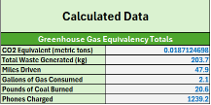
4. Waste reduction as a project outcome: IV to PO and beyond!
There are many examples of ways to use the waste and emissions calculators above to show sustainability focused outcomes in your projects and manuscripts. Check out a few examples!
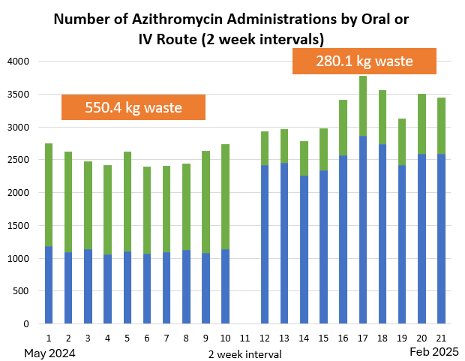
Following the large volume fluid bag shortage in October 2024, we evaluated the impact of a prescriber-facing alert to encourage oral doxycycline and azithromycin utilization at time of prescribing. The intervention led to a decrease in IV therapy prescribing and a solid waste savings of about 270 kg for azithromycin and 230 kg for doxycycline (with a bonus significant cost savings!).
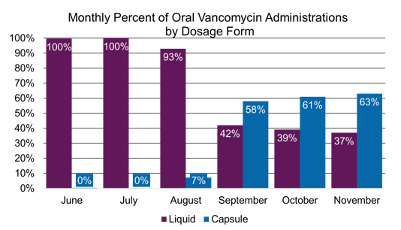
In the inpatient setting, drug delivery in liquid formulations requires more waste due to delivery devices (cups or oral syringes) compared to solid capsule or tablets. Our health system transitioned from compounded oral vancomycin suspension to capsules. Samantha Spencer, PharmD evaluated the 3-month waste diversion with this change. A total of 142 kg of waste was diverted from landfill due to this product change, including 124.3 kg from plastic, 17.3 kg from glass, and 0.87 kg from rubber). This is currently unpublished data.
Lydia Lu and colleagues evaluated the potential waste and CO2e emissions that could have been spared if oral acetaminophen, ibuprofen, and amoxicillin were dispensed as chewable tablets instead of liquid products, highlighting the plastic waste associated with liquid formulations. Liquid formulations many times have shorter expiration dating due to compounding with water. This could lead to waste due to expired product and inability to re-dispense a dose if returned to the pharmacy.
Plastic waste per drug by formulation:
| Acetaminophen | Ibuprofen | Amoxicillin | |
| Liquid plastic waste per dose | 9.3 gm | 9.3 gm | 2.6 gm |
| Tablet plastic waste per dose | 1 gm | 1 gm | 2.6 gm |
Dose-rounding policies can also impact waste, mainly by reducing the number of vials required to compound all doses in a hospital. Dominick Memoli described a dose-rounding policy for daptomycin. After evaluating daptomycin doses compounded in a three month period before and after the implementation of the dose-rounding protocol, the number of vials needed to compound each dose decreased from 1.57 to 1.51 vials per dose. That may not sound like much, but in the three-month study period, 44 vials of daptomycin were saved which accounted for significant cost savings and daptomycin waste reduction.
Additional ways to incorporate waste or CO2e emission reduction into evaluation of your antimicrobial stewardship and infectious diseases interventions include:
- Length of stay or readmission reduction outcomes: calculate CO2e emissions associated with one day in the ICU or on the regular nursing floor
- Travel to appointments or pharmacy: Calculate mile and GHG saved by medication sync program or transition to telehealth appointments. The EPA has a great tool you can use here.
- Utilize the plastic waste and CO2e emissions associated with an intervention that reduces days of antimicrobial therapy, deescalation, or IV to PO conversion
Evaluation of the environmental impact of medications is a blossoming topic! I hope you find some of these resources inspiring and include waste reduction outcomes in your projects and research.
Helpful Resources
- Sustainabil-ID: https://sustainabil-id.com/
- About: A collaborative community of infectious diseases physicians, infection preventionists, pharmacists, public health professionals, and trainees dedicated to integrating environmental sustainability into all aspects of infectious diseases.
- Check out research publications, laboratory optimization opportunities, and advocacy opportunities
- Cascades: https://cascadescanada.ca/
- RX for Climate: A global alliance for climate-smart pharmacy practice: https://www.rxforclimate.org/
- Practice Greenhealth: sustainability solutions for healthcare: https://practicegreenhealth.org/
- Healthcare Without Harm: leading the global movement for sustainable health care: https://noharm.org/
ADDITIONAL REFERENCES & RESOURCES
- SGS Glossary of Terms
- American Lung Association Climate and Health Basics Course
- Naga NG, et al. The silent microbial shift: climate change amplifies pathogen evolution, microbiome dysbiosis, and antimicrobial resistance. Tropical disease, travel medicine and vaccines 2025;11:43.
- GHG Protocol
- Mahalingaiah S, et al. Microplastics and human health. JAMA 2025;334(21):1941-2.
- Marfella R, et al. Microplastics and nanoplastics in atheromas and cardiovascular events. N Eng J Med 2024;390(10):900-10.
- Prasad PA, et al. Environmental footprint of regular and intensive care in a large US hospital. International journal of life cycle assessment.
- Gaetani M, et al. The carbon footprint of critical care: a systematic review. Intensive Care Med 2024;50(5):731-45
- Rodler S, et al. The impact of telemedicine in reducing the carbon footprint in health care: a systematic review and cumulative analysis of 68 million clinical consultations. Eur Urol Focus 2023;9(6):873-87.
DISCLAIMERS: The views and opinions expressed in this article are those of the author and may not represent the position or policy of any past, present, or potential future employer. AI was not used to develop this post.
ABOUT THE AUTHOR
Andrea Pallotta, PharmD, BCIDP, AAHIVP
Andrea Pallotta is the clinical coordinator for Infectious Diseases and HIV at Cleveland Clinic Main Campus and Antimicrobial Stewardship Lead for the Cleveland Clinic Health System. She works alongside a multidisciplinary team of caregivers to provide treatment for patients living with HIV in outpatient clinic and to coordinate antimicrobial stewardship efforts across the enterprise. Andrea practices in HIV prevention (PrEP) clinic and provides comprehensive HIV and STD prevention services. Andrea founded the Greening the Pharmacy Council with a vision of bringing together a diverse group of pharmacy caregivers committed to environmental resource sustainability efforts and advocacy for the health of our patients and communities.
RECOMMENDED TO YOU: