AI-Generated Summary: This article highlights five practical ways infectious diseases pharmacists can strengthen antimicrobial stewardship during the transition from hospital to home, including antimicrobial reconciliation, optimizing outpatient therapy, improving handoffs, following pending microbiology results, and patient education. It emphasizes that stewardship should follow the patient beyond discharge, helping ensure antimicrobial therapy remains appropriate, feasible, monitored, and safely completed at home.


Authored By: Saeed Aldosari, PharmD, BCPS, BCIDP and Mohanned Nasser, PharmD, BCIDP
Article Posted 8 September 2026
Introduction
Hospital discharge represents an important transition in antimicrobial therapy and is increasingly recognized as a source of antibiotic overuse. More than 1 in 8 patients receive an antimicrobial at hospital discharge, and approximately half of discharge antimicrobial prescribing may be improved.1 For common infections treated during hospitalization, a substantial proportion of the total antibiotic course may occur after the patient has already left the hospital.
Despite these opportunities, antimicrobial stewardship programs have historically focused more heavily on inpatient prescribing than on the transition from the hospital to home. A 2024 scoping review identified eight studies evaluating pharmacist antimicrobial stewardship interventions during inpatient-to-home transitions of care, including six studies in which the intervention was pharmacist-led and two in which pharmacists participated as members of the antimicrobial stewardship team.2 All eight studies included in that review concluded that pharmacists have a role in antimicrobial stewardship during transitions of care, although questions remain regarding optimal training, workflow, communication, and quality metrics.
Evidence also supports a specific role for pharmacists with infectious diseases expertise at discharge.3,4 In one study, an ID pharmacist reviewed 803 oral antimicrobial prescriptions at discharge and identified at least one drug-related problem in 43.1% of prescriptions.3 More recently, an ID-trained pharmacist-led program at four Mayo Clinic hospitals demonstrated the feasibility of following microbiology results that finalized after patients with an inpatient ID consultation had already been discharged.4
The goal of this article is to discuss five practical roles that infectious diseases pharmacists can play in extending antimicrobial stewardship from the bedside to the home.
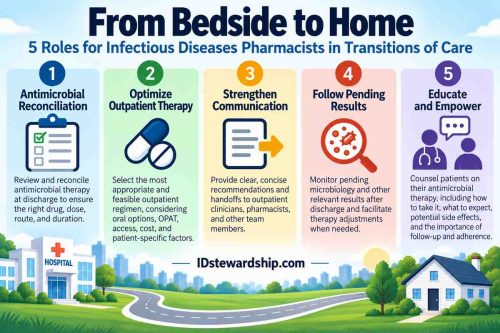
ROLE 1: Perform Antimicrobial Reconciliation Before the Patient Leaves
Medication reconciliation is an established patient-safety activity at transitions of care, and published evidence suggests that antimicrobials deserve the same deliberate review before discharge.2,5 In a prospective study of patients discharged on anti-infective therapy, medication errors were identified in 42% of the evaluated anti-infective regimens.5 A structured antimicrobial stewardship review resulted in accepted recommendations that prevented medication errors in 68% of patients in whom an error had initially been identified.
The types of problems found during discharge review are directly relevant to the expertise of an ID pharmacist.3 Among 803 discharge antimicrobial prescriptions reviewed by an ID pharmacist, the most frequently identified drug-related problems involved treatment duration, antimicrobial selection, and dose selection. The ID pharmacist recommended at least one intervention in 42.8% of the reviewed prescriptions, and 75.6% of the recommendations were accepted. When recommendations to shorten therapy were accepted, the median number of antimicrobial days dispensed decreased from 8 days to 4 days.
Transitions-of-care pharmacists have identified similar problems, with dosing, treatment duration, and drug interactions representing the three most common antimicrobial interventions in another hospital-based program.6 In that study, 80.5% of antimicrobial recommendations were accepted by prescribers, and pharmacist interventions avoided an estimated 109 days of antimicrobial therapy.
A practical antimicrobial reconciliation can therefore verify the indication, antimicrobial selection, dose, duration, inpatient days already completed, and intended stop date before the discharge prescription is finalized.3,7 A five-hospital pharmacist-led transitions-of-care program specifically incorporated collaborative selection of appropriate therapy and duration and facilitated discharge prescriptions with an appropriate stop date.7
- Practical pearl 1: A clearly defined stop date can help translate the intended total antimicrobial course into the discharge prescription rather than treating discharge as the beginning of a new course.
ROLE 2: Make Sure the Outpatient Antimicrobial Plan Works Beyond the Hospital
An antimicrobial regimen that is appropriate during hospitalization may require reassessment before it becomes an outpatient treatment plan. Important targets for discharge stewardship include avoiding unnecessary antibiotics, reducing excess duration, avoiding unnecessary fluoroquinolone exposure, and improving or avoiding intravenous antimicrobial therapy when appropriate.1
This becomes particularly important when outpatient parenteral antimicrobial therapy, or OPAT, is being considered. The IDSA OPAT guideline recommends infectious diseases expert review before initiation of OPAT and notes that unnecessary parenteral therapy when oral antimicrobial therapy would have been sufficient is a recognized form of inappropriate antimicrobial use.8 The guideline also describes pharmacists as members of the multidisciplinary team supporting patients receiving OPAT.
ID pharmacists can also identify practical barriers that may make an otherwise reasonable antimicrobial plan difficult to execute outside the hospital. In the transitions-of-care study by Leja and colleagues, pharmacist antimicrobial interventions included drug interactions, high cost or difficulty obtaining the medication, incorrect instructions, medication-reconciliation discrepancies, allergies or intolerance, and the need for refills.6
Patients receiving OPAT also require continued monitoring rather than simply an intravenous antimicrobial prescription. IDSA recommends serial laboratory monitoring for patients receiving OPAT and emphasizes that effective monitoring requires both performance of the laboratory tests and availability of the results to the team overseeing therapy.8 Effective OPAT laboratory monitoring has been associated with a reduced risk of hospital readmission in the evidence reviewed by the guideline panel.
- Practical pearl 2: Before discharge, the ID pharmacist should consider not only whether the antimicrobial is clinically appropriate, but whether the planned route, monitoring, interactions, access, and follow-up make the regimen practical for the patient after leaving the hospital.
ROLE 3: Create an Antimicrobial Handoff, Not Just a Medication List
Poor communication across healthcare settings is a recognized barrier to effective antimicrobial stewardship at hospital discharge. Published transitions-of-care stewardship models have therefore incorporated collaborative planning and communication regarding antibiotic selection and duration before discharge.7
A pharmacist-led five-hospital model used multidisciplinary collaboration among pharmacists, physicians, nurses, and case managers to identify patients expected to leave on oral antimicrobials and develop an appropriate discharge antimicrobial plan.7,9 Clinical pharmacists then helped facilitate documentation and entry of the antimicrobial discharge prescription.
For ID pharmacists, this creates an opportunity to communicate more than the medication name alone. A useful antimicrobial handoff can bring together the infection being treated, antimicrobial selected, intended duration or stop date, necessary monitoring, and responsibility for outpatient follow-up.7,8 When microbiology remains pending, the handoff should also make clear that additional results require follow-up after discharge.4
This communication may be particularly important when several groups participate in the patient’s antimicrobial care, such as the inpatient team, ID service, outpatient ID clinic, OPAT team, infusion pharmacy, home-health service, or another receiving healthcare facility. The IDSA OPAT guideline emphasizes multidisciplinary collaboration among physicians, pharmacists, nurses, vascular-access teams, and other healthcare professionals in supporting outpatient parenteral therapy.8
- Practical pearl 3: The next clinician should be able to determine what infection is being treated, what antimicrobial plan was intended, and when that treatment should end without reconstructing the entire hospitalization.
ROLE 4: Close the Loop on Microbiology and Monitoring That Remain Pending After Discharge
Pending diagnostic results are a recognized vulnerability during transitions of care. Published estimates cited by Van Abel and colleagues suggest that as many as 41% of patients may leave the hospital with a pending test result and that up to 9.4% of pending results may be clinically actionable.4
This creates a particularly relevant opportunity for ID pharmacists because bacterial identification, antimicrobial susceptibility testing, fungal cultures, mycobacterial cultures, and other microbiology may not be finalized when a patient leaves the hospital. Mayo Clinic implemented a post-discharge microbiology monitoring process in which ID-trained pharmacists reviewed updated microbiology results among patients who had received an inpatient ID consultation.4
Across 6,792 patient encounters with at least one post-discharge microbiology result reviewed, 1,977 encounters, or 29%, required at least one intervention.4 The median time from microbiology-result update to clinical review was 27.2 hours. Among the sampled interventions that underwent severity assessment, 28% received the highest severity rating, indicating that failure to intervene could potentially have resulted in patient harm.
The pharmacist’s role in that program extended beyond simply changing antimicrobial therapy and included actions such as recommending additional microbiologic testing, adjusting antimicrobial doses, and identifying the need for ID-clinic follow-up.4 Results could also be triaged to an ID physician or advanced practice provider for additional review when appropriate.
The same closed-loop principle applies to laboratory monitoring during OPAT. IDSA specifically notes that effective OPAT laboratory monitoring requires results to reach the clinician or team overseeing the outpatient course.8
- Practical pearl 4: A pending microbiology result is not truly followed until someone is identified to review it, interpret it, and act on it when necessary.
ROLE 5: Help the Patient Safely Reach the Antimicrobial Finish Line
Hospital discharge can involve discontinuity of care, multiple medication changes, and inadequate patient education, all of which can contribute to medication-related problems after hospitalization. Pharmacists can address these risks through medication review, discharge counseling, and post-discharge follow-up.10
In a randomized trial, pharmacist discharge counseling included clarification of the medication regimen, review of medication indications and directions, discussion of potential adverse effects, and identification of adherence barriers.10 Patients in the pharmacist-intervention group also received a follow-up telephone call 3 to 5 days after discharge. Preventable adverse drug events within 30 days occurred in 1% of patients receiving the pharmacist intervention compared with 11% in the control group.
Antimicrobials introduce additional counseling opportunities because discharge-related pharmacist interventions frequently involve treatment duration, drug interactions, medication access, and incorrect instructions.6 These findings support reviewing with patients why the antimicrobial is being used, how it should be taken, relevant interactions or adverse effects, and when the planned therapy ends.6,10
Pharmacist involvement at discharge has also been associated with substantial improvements in antimicrobial prescribing. In a 2026 quasi-experimental study, appropriate discharge antibiotic prescribing increased from 25% under standard care to 85% with pharmacist assessment, while broad-spectrum antibiotic use decreased from 49% to 26%.11 Pharmacist involvement was also associated with a three-day reduction in median antibiotic exposure, with no significant difference observed in the measured secondary clinical outcomes.11
- Practical pearl 5: Before the patient leaves, confirming that they understand why they are taking the antimicrobial, how to take it, and when the final dose is due can make patient education part of the antimicrobial stewardship intervention.
Closing Thoughts
Antimicrobial stewardship should extend beyond the inpatient stay because a meaningful proportion of antimicrobial therapy is prescribed or completed after hospital discharge. Discharge-specific stewardship strategies have been associated with lower antibiotic overuse, and direct antibiotic review before discharge has demonstrated particularly consistent benefit.1
Pharmacist-led interventions have improved antimicrobial prescribing at discharge across different healthcare systems and practice models.2 A five-hospital pharmacist-driven intervention increased optimal discharge antimicrobial prescribing and was associated with fewer severe antimicrobial-related adverse effects without significant differences in clinical resolution or mortality.9 An ID-pharmacist review program similarly identified drug-related problems in more than 40% of discharge antimicrobial prescriptions reviewed.3
The ID pharmacist can therefore contribute at multiple points in the transition from hospital to home: reviewing the final antimicrobial regimen, helping determine whether the outpatient treatment strategy is appropriate and feasible, strengthening communication of the antimicrobial plan, following results that remain pending after discharge, and educating patients about safe completion of therapy.3,4,8,10
The prescription may leave the hospital with the patient, but antimicrobial stewardship should follow it home.
References
1. Vaughn VM, Hersh AL, Spivak ES. Antibiotic Overuse and Stewardship at Hospital Discharge: The Reducing Overuse of Antibiotics at Discharge Home Framework. Clin Infect Dis Off Publ Infect Dis Soc Am. 2022;74(9):1696-1702. doi:10.1093/cid/ciab842
2. Danchuk-Lauzon M. Pharmacist-led antimicrobial stewardship at transitions of care from inpatient hospital to home: a scoping review. Antimicrob Steward Healthc Epidemiol. 2024;4(1):e108. doi:10.1017/ash.2024.349
3. Parsels KA, Kufel WD, Burgess J, et al. Hospital Discharge: An Opportune Time for Antimicrobial Stewardship. Ann Pharmacother. 2022;56(8):869-877. doi:10.1177/10600280211052677
4. Van Abel AL, Virk A, Cole K, et al. Impact of pharmacist-led microbiology result follow-up post-discharge for patients undergoing inpatient infectious diseases consultation. Antimicrob Steward Healthc Epidemiol ASHE. 2024;4(1):e111. doi:10.1017/ash.2024.348
5. Su CP, Hidayat L, Rahman S, Venugopalan V. Use of an Anti-Infective Medication Review Process at Hospital Discharge to Identify Medication Errors and Optimize Therapy. J Pharm Pract. 2019;32(5):488-492. doi:10.1177/0897190018761411
6. Leja N, Collins CD, Duker J. Antimicrobial Stewardship by Transitions of Care Pharmacists at Hospital Discharge. Hosp Pharm. 2021;56(6):714-717. doi:10.1177/0018578720951170
7. Patel N, Davis SL, MacDonald NC, et al. Transitions of care: An untapped opportunity for antimicrobial stewardship. JACCP J Am Coll Clin Pharm. 2022;5(6):632-643. doi:10.1002/jac5.1620
8. Norris AH, Shrestha NK, Allison GM, et al. 2018 Infectious Diseases Society of America Clinical Practice Guideline for the Management of Outpatient Parenteral Antimicrobial Therapy. Clin Infect Dis. 2019;68(1):e1-e35. doi:10.1093/cid/ciy745
9. Mercuro NJ, Medler CJ, Kenney RM, et al. Pharmacist-Driven Transitions of Care Practice Model for Prescribing Oral Antimicrobials at Hospital Discharge. JAMA Netw Open. 2022;5(5):e2211331. doi:10.1001/jamanetworkopen.2022.11331
10. Schnipper JL, Kirwin JL, Cotugno MC, et al. Role of pharmacist counseling in preventing adverse drug events after hospitalization. Arch Intern Med. 2006;166(5):565-571. doi:10.1001/archinte.166.5.565
11. Ly K, Do T, Rivera-Torres N. Bridging the Gap in Antibiotic Stewardship at Hospital Discharge: Evaluating the Impact of Pharmacist Interventions. J Am Coll Clin Pharm JACCP. 2026;9(2):e70124. doi:10.1002/jac5.70124
Disclosures: The authors report no conflicts of interests or special disclosures. AI was used as a writing support tool, primarily to assist with language refinement, clarity, organization. All scientific content, interpretations, and references were independently reviewed and verified by the authors.
About the Authors

Saeed Aldosari, PharmD, BCPS, BCIDP earned his first Doctor of Pharmacy degree from Taif University in Saudi Arabia in 2015 and his second Doctor of Pharmacy degree from Nova Southeastern University College of Pharmacy in Florida in 2022. He completed his PGY-1 pharmacy residency followed by specialized PGY-2 training in Infectious Diseases at Tufts Medicine MelroseWakefield Hospital. He currently serves as an Infectious Diseases Pharmacist and Health Outcomes Fellow at Nova Southeastern University College of Pharmacy. His professional and research interests include antimicrobial stewardship, diagnostic stewardship, antimicrobial resistance, and infectious diseases treatment outcomes.

Mohannad Nasser, PharmD, BCIDP earned his first Doctor of Pharmacy degree from King Abdulaziz University Faculty of Pharmacy in Saudi Arabia in 2015 and his second Doctor of Pharmacy degree from Nova Southeastern University College of Pharmacy in Florida in 2021. He completed his PGY-1 pharmacy residency followed by specialized PGY-2 training in Infectious Diseases at Tufts Medicine MelroseWakefield Hospital. He currently serves as an Infectious Diseases Clinical Pharmacist and Deputy Director of the PGY-2 Infectious Diseases Pharmacy Residency Program at King Faisal Specialist Hospital and Research Centre in Jeddah, Saudi Arabia.
RECOMMENDED TO YOU