AI-generated summary
The article features an interview with Dr. Sundus Maria, an infectious diseases pharmacist in Pakistan, highlighting the evolving but challenging landscape of antimicrobial stewardship (AMS) in the country and the key roles pharmacists play in promoting rational antibiotic use within hospitals and at the national level. It also discusses ongoing efforts to strengthen AMS through training, policy development, and collaboration while noting barriers like limited resources, over-the-counter antibiotic access, and the need for broader awareness and implementation of stewardship practices.


Interviewee: Sundus Maria, Pharm.D, M.Phil, BCIDP

Interviewer: Timothy P. Gauthier, Pharm.D., BCPS, BCIDP
Article Posted 11 December 2025
Introduction
This article is part of an ongoing series about antimicrobial stewardship around the world. Other countries covered thus far include Nigeria, India, Bangladesh, Uganda, Thailand, Japan, Costa Rica, Australia, New Zealand, Canada, Spain, United Kingdom, and Turkey. Here, we seek to learn from others and share stories of our progress on stewardship globally. Dr. Maria was kind enough to weigh in on her experiences and I hope you will be able to learn from her here about antimicrobial stewardship in Pakistan.
About Dr. Maria
My name is Sundus Maria, and I am currently serving as an Assistant Manager and Pharmacy Residency Program Director at Shifa International Hospital.
My area of specialization is Infectious Diseases (ID), and I hold certifications from SIDP and BPS. For the past five years, I have been serving as the Secretary of the Antibiotic Stewardship Program Subcommittee, where I have actively contributed to the implementation of antibiotic restriction policies across inpatient settings.
As an ID pharmacist, my work includes conducting Drug Utilization Reviews (DURs), providing feedback to prescribers, and contributing to the development of clinical guidelines, their implementation and compliance monitoring. I also serve as the Editor of the Antimicrobial Stewardship Program (ASP) Quarterly Newsletter, a platform that highlights stewardship activities and achievements within our institution.
Further, I am currently engaged nationally as a coordinator for GARP-Pakistan (Global Antibiotic Resistance Partnership) in which the members are working on a policy brief for the role of vaccines in mitigating antimicrobial resistance (AMR) and the Fleming Fund Project, where we focus on strengthening antimicrobial stewardship (AMS) capacity as well as supporting stewardship initiatives across multiple hospitals in Pakistan.
Stewardship in Action: ASP Committee Meeting
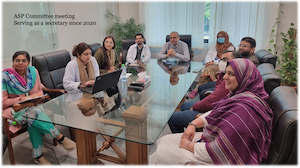
1. How did you get interested in antimicrobial stewardship as a pharmacist and what path did you take to reach where you are today?
When I began my journey in clinical pharmacy back in 2019, I started as a critical care pharmacist. Things took an unexpected turn when our infectious diseases pharmacist resigned and, to my surprise, she nominated me as her replacement. She was SIDP-certified and had exceptional ID-related knowledge, so naturally, I was nervous about stepping into her shoes.
I requested that our Chief Pharmaceutical Officer, Ms. Salwa Ahsan, a strong advocate of antimicrobial stewardship and my mentor, that the hospital sponsor my SIDP certification so I could perform my new responsibilities more effectively. I took my time completing the certification, and around that period, COVID-19 struck. Despite the challenges, the pandemic opened up new opportunities for us: we conducted DURs, developed hospital-specific guidelines and protocols, created educational flyers, and continued our AMS meetings virtually.
At that time, I still hadn’t fully grasped the true essence of antibiotic stewardship. I clearly remember when we were working on developing the ‘Linezolid Usage Criteria’ during a discussion with our Infectious Diseases physician, he asked if I had read the IDSA ASP guidelines. I was embarrassed to admit that I hadn’t. He advised me to go through them, and honestly, even then, I didn’t. Back then, I was more focused on learning bugs and drugs while ASP seemed a bit dull and dry topic.
For quite some time, I remained torn between critical care and infectious diseases. That’s one of the reasons I delayed pursuing my board certification. I was serving as the ASP committee secretary while simultaneously doing daily ICU rounds, trying to balance both worlds.
Everything changed during my first World Antimicrobial Awareness Week (WAAW) in 2021. I still remember asking my Chief Pharmaceutical Officer to deliver a talk on “The Role of Pharmacists in AMS.” To my surprise, she firmly told me that it was time for me to take the lead. That session became my first-ever educational presentation as an ID/ASP pharmacist.
Stewardship in Action: Antibiotic Awareness Week
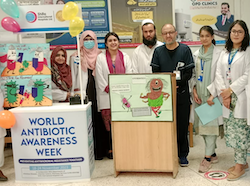
While preparing for it, I finally referred to the IDSA ASP guidelines and that was my lightbulb moment. I realized how closely our practices aligned with international standards and how every strategy of stewardship had a clear, evidence-based purpose. From that day onward, everything started to make sense. I began taking a deep, genuine interest in ASP, and each small victory (like a successful practice change in a specific specialty) felt immensely rewarding. Those wins made me feel that we were truly making a difference.
I also attended my first virtual IDweek in 2021, from that moment on, there was no turning back. I had found my passion, antimicrobial stewardship, and I was fully committed to it.
2. What is the status of antimicrobial stewardship in Pakistan, based on what you see in your practice
Antimicrobial Stewardship (AMS) is still an evolving concept in Pakistan. Most healthcare professionals are far more familiar with Infection Prevention and Control (IPC) than with AMS itself.
Pakistan developed its National Action Plan against Antimicrobial Resistance (AMR) in 2017; however, its on-ground implementation remains limited. To complement this, the National Antimicrobial Stewardship Plan (NASP) is now being developed to support national efforts focused on antimicrobial consumption, utilization, and resistance. Similarly, the Drug Regulatory Authority of Pakistan (DRAP) launched the first edition of national guidelines on the responsible use of antimicrobials in human health, but once again, the key challenge lies in execution.
While numerous institutions are conducting valuable research and surveys on AMR, the development and implementation of hospital-based Antimicrobial Stewardship Programs (ASPs) still have a long journey ahead. One of the major obstacles across both public and private sector hospitals is the lack of cooperation and coordination among healthcare professionals.
At the national level, AMR and IPC sentinel sites have been established to support NASP and our hospital is one of the sites. Organizations such as the Fleming Fund and GARP (Global Antibiotic Resistance Partnership) are also actively contributing to AMR containment efforts in Pakistan.
Under the Fleming Fund’s collaboration with Shifa International Hospital, our team visited multiple local healthcare facilities to provide training on AMS and IPC. Meanwhile, through GARP, where I serve as a coordinator, we are developing a policy brief aimed at mitigating AMR through the promotion of vaccination in Pakistan.
Despite these ongoing initiatives, Pakistan continues to face challenges like other developing nations. Antibiotics remain readily available over the counter, and public awareness regarding their rational use is minimal. Within hospitals, there is an urgent need to enforce antibiotic restriction policies and implement evidence-based prescribing guidelines. From prolonged broad-spectrum surgical prophylaxis to prescribing under peer pressure, the challenges numerous.
And this is just the human sector, the animal and agricultural sectors also are facing numerous challenges.
3. What are pharmacists in Pakistan doing to improve antimicrobial stewardship?
Pharmacists are the custodians of antibiotics. Whether or not they formally identify as ID pharmacists, their stewardship instinct naturally activates the moment they encounter an inappropriate antibiotic prescription.
In recent years, there has been a remarkable rise in interest among pharmacists toward AMS. Increasingly, pharmacists are eager to learn about effective strategies and solutions to combat Antimicrobial Resistance AMR. Today, pharmacists are not only part of the discussions, in some cases, they are also leading them. I once visited a hospital where the pharmacist had developed their first ever antibiogram!!
Through the Pakistan Society of Health-System Pharmacists (PSHP), numerous pharmacists across the country have been trained in ASPs. Within my own institution, we have also extended AMS and IPC training to several local hospitals.
Across Pakistan, pharmacists are contributing in diverse ways from prescription reviews, dose optimization, and Defined Daily Dose (DDD) calculations, to promoting rational antibiotic use. The passion is undeniable. Most pharmacists I’ve met are highly motivated to make a difference. Yet, limited resources often hinder their progress. In some hospitals, there is no pharmacist at all, while in others, a single pharmacist oversees an entire 1,500-bedd facility. In such environments, it becomes incredibly challenging to maintain motivation or see a clear path forward.
That said, I believe we still need to push harder. What we truly lack is collaboration and platforms or forums where pharmacists can share data, exchange experiences, and learn from each other’s stewardship efforts.
At my own institution, where I serve as Clinical Pharmacy Assistant Manager, every clinical pharmacist is engaged in some form of AMS activity, whether it’s conducting DURs for restricted antibiotics, monitoring DDDs, performing Vancomycin AUC/MIC therapeutic drug monitoring (TDM), supporting IV-to-oral switch programs, preparing > 5-day antibiotic reports, reviewing renal dose adjustments, or developing clinical guidelines.
Antimicrobial Stewardship is not a one-man show, it thrives on teamwork. We are fortunate to have an exceptional Infectious Diseases, Microbiology, and Infection Control team, all working in close collaboration and mutual respect. Their acknowledgment and support have been integral to the success of our stewardship initiatives.
4. What is the most important lesson you have learned when it comes to antimicrobial stewardship?
I’ve learned not just one, but countless lessons throughout my journey in antimicrobial stewardship. I consider myself fortunate to have experienced nearly all ASP strategies, both core and supplemental, in their true sense and spirit.
The first and most important lesson is to always start by targeting the low-hanging fruits when initiating an ASP. If you begin with an overly ambitious step such as implementing antibiotic restrictions right away you might risk early failure and lose team motivation. Focusing on small, achievable goals builds confidence, demonstrates progress, and keeps the team inspired to move forward.
The second lesson is that practice change does not happen overnight. It takes time, persistence, and consistency. You need a great deal of patience sometimes, it may take months to implement even a single intervention, but when it finally happens, every effort feels worthwhile. In our case, implementing restrictions of antibiotics took a lot of time and effort, we still face compliance issues but whenever we can we share feedback.
That brings us to my next lesson, communication and data are everything and feedback ties it all together. Always share feedback with your physicians, colleagues, and administration. It sustains momentum and fosters collaboration. Without data, it’s hard to convince anyone, data is power in stewardship.
And lastly, I’ve learned to embrace humility, you never truly know everything. The more I learn, the more I realize how much there is still left to discover.
5. What do you predict the future holds for antimicrobial stewardship in Pakistan?
The future of AMS in Pakistan is promising but challenging. There is a growing awareness of AMR and AMS at both institutional and national levels, and the momentum is stronger than ever before.
The development of the NASP and the increasing involvement of organizations like the Fleming Fund, NITAG, GARP, PSHP, and others mark an important shift , from isolated efforts to more structured national coordination.
In the coming years, I hope to see more hospitals adopting ASPs, training opportunities for pharmacists, physicians, and microbiologists with AMS being integrated into both undergraduate and postgraduate curricula.
Since it is the age of AI and digitalization, I really hope to see digital transformation in AMS, through the use of data dashboards, electronic prescribing, and real-time antibiotic use surveillance.
We need Community-level initiatives, targeting over-the-counter antibiotic misuse and public education campaigns, which will be crucial for sustainable impact.
However, the biggest hurdle will remain resource allocation and enforcement. Without administrative support, manpower, and protected time for AMS teams, progress will be slow. But the foundation has been laid and with persistent advocacy, data-driven interventions, and national collaboration, Pakistan’s AMS landscape is poised to grow stronger and more structured in the coming decade.
I remain deeply hopeful, because being an antibiotic steward means believing that change is always possible, we simply cannot lose hope.
My fellow pharmacists in local government hospitals often remark that I am fortunate to work in a JCI-accredited hospital, where implementing ASP initiatives is relatively easier. While I wouldn’t completely disagree as we do benefit from administrative support and structured policies but still the journey since 2020 both as an ID pharmacist and for the ASP committee has been far from simple. It has required consistent effort, collaboration, and patience. We give feedback to doctors via letters that are handed out personally rather than sending emails, as it gives an opportunity to have a face to face discussion and there were times that I was politely told to mind my own business but there were also moments when we were appreciated and proper reasoning for antibiotic use was given …and over the quarters we noticed a change in the practice of these doctors whom we had given the letters.
That’s the power of feedback. So yes, even though we have effective strategies and systems in place that allow us to respond actively, we face challenges but there is always a success story every now and then.
References & Readings
- Pakistan’s National Action Plan Against Antimicrobial Resistance
- AMR battle in Pakistan: from national action plans to local failures
- Reporting immunization coverage inequalities in Pakistan
- Gaps and Barriers to the Implementation of Antimicrobial Stewardship Programmes in Hospitals of Pakistan
- Shifa Newsletters
RECOMMENDED TO YOU