
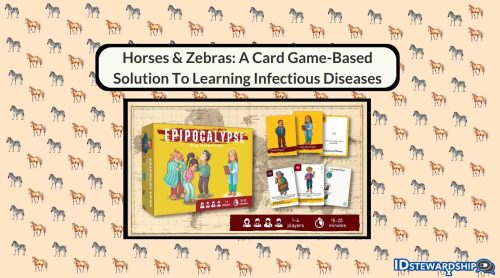
Epipocalypse: Bug Detectives transforms the slog of memorizing infectious diseases into a clever card game where players hunt for “horses” and spot elusive “zebras.” It’s a fun, strategy-filled way to lock in pathogens, vectors, and diagnoses — turning study time into something you’ll actually look forward to.

Authored By: Scott Crabtree, M.D., MPH
Article posted 28 September 2025
“If you hear hoofbeats, think of horses not zebras.”
This statement, and variations of it, is a commonly cited aphorism in medicine. For every exotic disease there are one hundred more instances of commonly encountered conditions. The day-to-day practice of medicine therefore should start with the consideration of common conditions, horses, and not, at least from the start, strain to make everything into a rare disease, a zebra. This is good practice in general, but practiced absolutely will lead to missed diagnoses and delayed and ineffective care. Hence the also oft stated follow up:
“But don’t dismiss the stripes when you see them.”
There is never more true than in the diagnosis and management of infectious diseases where the differential can be expansive and the treatments diverse. While vancomycin and piperacillin-tazobactam will get you through many infections, most zebras are naturally resistant.
Unfortunately recognizing the stripes of the world’s zebras and other hooved mammals requires a lot of memorization, not just of their clinical picture but their geographic distribution, vectors, reservoirs, and other epidemiological factors related to their transmission and therefore probability of being present. Zebras are rare in the US, but not in Africa. This in turn begs for tools to make memorizing easier. Here, now, is a brief list of memorization techniques recommended by the University of North Carolina, some examples in medicine, and a fun, new option incorporating many of them, Epipocalypse: Bug Detectives. A fast playing, easy to learn, medical education card game.

1. Flash Cards. Everyone knows what flash cards are. A card with a small amount of information or sometimes individual fact or definition on one side and the concept on the other. They offer bite sized chunks of knowledge allowing for “distributed practice,” an important component of generating long term memory. Anki is an open-source, digital flash card platform that allows individuals to create and share flash cards with some decks exceeding tens of thousands of cards. It has cards for probably every medical topic.
2. Concept Mapping. Concept mapping is the practice of drawing concepts in an organized often schematic way where nodes branch and connect similar concepts and disease processes together in an organized manner. This process incorporates visual spatial knowledge, which facilitates easier active recall, and active recall itself, which is more effective than passive review. Draw It to Know It is an online platform that uses this in the form of video and practice drawing to teach a broad range of medical topics.
3. Mnemonics. Mnemonics are simple memory tricks that utilize words, phrases, or patterns of letters to group and link a shared set of concepts or phenomena. By creating meaningful groups, they chunk data for easier learning, and by connecting them to easy to remember words and phrases they aid recall. Sometimes they can take on the form of jingles or short stories to make them even more memorable, particularly as talking aloud can also itself aid recall. There are no big medical mnemonic warehouses out there that I am aware of, but Wikipedia has a page dedicated to a nearly exhaustive list.
4. Memory Palaces – Memory palaces are founded on the fact that visual spatial memory is often more easily recalled than rote memorization. By connecting visual images, and in some cases entire rooms or scenes, to specific medical facts and information, a process called “dual coding,” you make the latter more accessible. Probably the most widely used example of this in medical learning is Sketchy which has entire sections dedicated to microbiology & infectious disease.
5. Multiple Choice Tests. Multiple choice exams are a recurring part of medical education, and the use of practice tests and smaller bites of practice questions provide essential practice. They, like all these methods, encourage active recall. Multiple companies offer multiple choice tests including Kaplan, AMBOSS, UWorld, and more.
6. Games. Educational games can combine many of the learning methods listed above in a package that also, if well done, is entertaining. While they probably won’t replace your favorite tabletop or console game, a good educational game can set itself apart from all other studying methods by making the study process more enjoyable. After all, a tool is only as useful as often as it’s used.
Epipocalypse: Bug Detectives, with its vast use of art and iconography, leverages dual coding while its comprehensive approach to infectious disease epidemiology, including geography, vectors, reservoirs, and more, allows for “interleaving,” the concept that changing subjects periodically stimulates active recall thereby accelerating learning.
The ready-to-go nature of a card game allows for super easy distributive learning.
Sources:
1. The Learning Center – University of North Carolina at Chapel Hill. “Memorization Strategies.” 15 July 2025, https://learningcenter.unc.edu/tips-and-tools/enhancing-your-memory/
2. Sumeracki MA, Weinstein Y. Six Strategies for Effective Learning. Acad Med. 2018 Apr; 93(4):666.
RECOMMENDED TO YOU

