AI-Generated Summary: The fight against antimicrobial resistance is a moving target, with pathogens continually developing new ways to evade treatment. To provide the best care, healthcare professionals must embrace lifelong learning and apply the latest evidence to everyday practice.

Authored by: Asma’ Soud Zinati
Senior Infectious Diseases Clinical Pharmacist, Antimicrobial Stewardship Committee Leader, Basheer Hospital, Amman, Jordan
Article posted 16 July 2026
THE QUIET WAR
Long before humans built hospitals, before white coats and prescription pads, bacteria were already fighting each other in the soil. They made weapons. They made shields. They learned to survive.
This silent battle raged for eons without any package inserts nor guidelines. The rule was simple: adapt, or die.
Then came 1928. A messy lab in London. A forgotten petri dish. A tiny mould spore drifted through an open window and landed on a plate of staphylococcus bacteria. Alexander Fleming noticed something strange: around the mould, the bacteria had died. That mould was producing penicillin. And with that, the world changed forever.
Suddenly, we had a miracle in our hands. Infections that would have kill now healed in days. Soldiers survived wounds. Children survived fevers. Penicillin became the hero of medicine. But Fleming, the quiet man who found the mould, also saw the shadow behind the light.
In 1945, during his Nobel lecture, Fleming said something that should have made the whole world stop and listen:
“There is the danger that the ignorant man may easily under-dose himself and by exposing his microbes to non-lethal quantities of the drug make them resistant.”
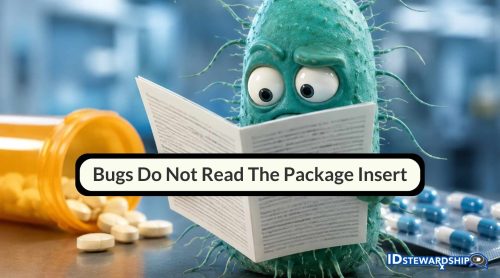
He was telling us something simple and terrifying: the bug does not read the package insert. It does not care about the right dose, the right duration, or the smart policy we wrote on paper. Give it a weak, half-hearted attack, and the bug will learn. And then it will come back stronger.
We did not listen. And the monster started to grow.
THE MONSTER GROWS QUIETLY
Within a few years of penicillin’s triumph, some bacteria had already learned to break the drug apart. We answered with a new drug: methicillin. The bacteria answered back with MRSA. We used vancomycin; they gave us VRE. We turned to carbapenems, our last resort, and soon we faced CRE — ‘superbugs’ that laughed at almost everything we had.
Why did this happen so fast? Because bacteria multiply in minutes, not years. While we spend months writing new guidelines, the bug has already changed, adapted, and shared its new resistance genes with friends. We kept treating antibiotics like ordinary medicines. But they are not ordinary.
When you use an antibiotic wrongly, you do not just fail to treat the patient in front of you. You teach the entire microbial world a new trick.
The package insert says ‘take for 5 days.’ The bug does not read that. The leaflet says ‘use the narrowest spectrum possible.’ The bug does not care. If we give a broad-spectrum, careless antibiotic, we kill the weak bacteria and leave the resistant ones an empty playground to multiply in.
The bug does not follow our policy. It only follows one law: survive.
EIGHT QUESTIONS BEFORE PRESCRIBING
If the bug ignores our leaflets, we must become smarter than the leaflet. Every time we reach for a prescription pad, pause and ask:
1. ASK: WHAT EXACTLY ARE WE TREATING?
Try to get a culture when it is reasonable. Find out the name of the bug and what kills it when you can. Treating a real enemy is better than bombing a whole city just in case.
2. ASK: WHAT WORKS HERE, IN OUR OWN HOSPITAL?
Every hospital has its own pattern of resistance. The textbook might say one thing, but our local antibiogram tells the real story. Use it and tap your local experts when you need help.
3. ASK: WILL THE DRUG REACH THE INFECTION SITE?
Not every drug goes to every place in the body. A drug that works in the blood might not reach the lungs, the brain, or a deep abscess. The right drug must reach the right place, just like the fighter must reach the battleground.
4. ASK: WHO IS THE PATIENT?
Age, kidney function, liver health, allergies, pregnancy — all these can change the game. A normal dose for one person might be poison for another. One size does not fit all. The dose is the poison.
5. ASK: CAN WE BE NARROW INSTEAD OF BROAD?
Start with a smart guess, but once the lab tells us the real enemy, narrow the attack. Use the smallest weapon that does the job. As the campaign from the UK Government goes – Start Smart, Then Focus!
6. ASK: HOW MANY DAYS ARE REALLY NEEDED?
Shorter courses often work just as well and do less harm. Every extra day is another training session for the bugs and a risk for the patient. Stop when it is safe for the patient, not because of a non-specific number assigned to an entire infectious syndrome.
7. ASK: WHAT IS THE HIDDEN COST?
Antibiotics disturb the good bacteria in the gut. They can cause C. difficile diarrhea. They can select resistant bugs that will harm the next patient who occupies that bed. Antibiotic use has repercussions beyond a single patient, we must see them as the societal drugs they are. Think beyond today.
8. ASK: ARE GUIDELINES MAPS OR PRISONS?
A guideline is wise, but the patient in front of you may not fit the picture. Use your brain alongside the book. As Dr. Spellberg & Dr. Shorr said – with opinion based recommendations, beware the tyranny of experts.
THE REAL ANSWER IS NOT A NEW DRUG. IT IS US.
It is tempting to hope for a miracle — a brand new antibiotic that will finally outsmart the superbugs. But history shows us the painful truth. Even when a new drug arrives, resistance follows quickly if we misuse it. The pipeline of new antibiotics is almost dry. We cannot simply buy our way out of this problem.
The real solution is antimicrobial stewardship.
Stewardship is not a boring committee that tells you what you cannot prescribe. Stewardship is a way of thinking and a lifestyle.
Get into the habit of asking every day: Can I stop this antibiotic? Can I narrow it? Can I give a shorter course? Be the nurse who asks if the drug is still needed. Be the pharmacist who suggests a dose adjustment. Be the doctor who pauses before writing that broad-spectrum prescription ‘just to be safe.’ It is all of us, working together, to protect the miracle we still have.
A good stewardship program does not just save lives today. It keeps our powerful drugs working for the patients of tomorrow. It treats the hospital as an ecosystem, not just a building. And it finally takes Fleming’s warning seriously, turning it from old words into daily action.
ONE LAST THOUGHT
The bug will never read the package insert. That fact will not change. But we can change. We can stop imagining that our leaflets and guidelines are binding contracts with the microbial world. They are not.
The only thing that matters is what we actually do, at the bedside, every single day. Our job is not just to cure the patient in front of us. It is to make sure that, ten years from now, a young doctor can still reach for a simple antibiotic and watch it work. That only happens if we become true stewards of the miracles Fleming left us.
The more we use antibiotics, the more we lose antibiotics. The bugs adapt. So must we.
ABOUT THE AUTHOR
Asma’ Soud Al Zinati is a Board-Certified Pharmacotherapy Specialist (BCPS) and Board-Certified Infectious Diseases Pharmacist (BCIDP) with over 15 years of clinical experience. She serves as Antimicrobial Stewardship (AMS) Leader at Basheer Hospital in Amman, Jordan, where she focuses on tailored infectious disease therapy and patient-centered antimicrobial stewardship. She earned her pharmacy degree from Jordan University of Science and Technology. Asma’ is passionate about translating complex science into compelling narrative stories that connect with clinicians and the public alike.
DISCLOSURE: The author reports no commercial conflicts of interest.
RECOMMENDED TO YOU