AI-Generated Summary: The article argues that while social media is dominated by individuals with large reach but limited expertise, the pharmacy profession has not sufficiently established its own credible voices—digital opinion leaders—to counter widespread medication misinformation. It calls for pharmacists and professional organizations to actively develop and support these digitally engaged experts to ensure accurate, evidence-based information reaches the public.
Authored By: Timothy P. Gauthier, Pharm.D., BCIDP
Article posted: 26 April 2026
Social media communities are vast, dynamic, and constantly evolving. Platforms rise, fall, and sometimes re-emerge—but their ability to reach large audiences remains unmatched. While usage patterns vary, social media is now deeply embedded in the daily lives of millions.
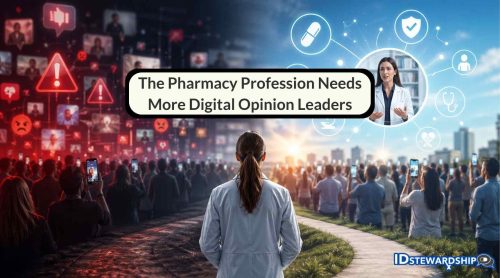
At the 2026 European Society for Clinical Microbiology and Infectious Diseases (ESCMID) Global Congress, Dr. Akshatha Ravindra (@IDdocAkshatha), an infectious diseases physician from India delivered a thought-provoking talk on the current state of social media. One particularly compelling framework she shared was the distinction between key opinion leaders (KOLs), social media influencers (SMIs), and digital opinion leaders (DOLs).
KOLs are experts—individuals with deep knowledge, academic credibility, and a strong track record of research and publication. However, they often have limited presence on social media, and therefore limited reach in that space.
SMIs, on the other hand, may have little to no subject-matter expertise but possess enormous audiences. Their ability to amplify messages—accurate or not—is significant. Most of us can think of accounts with millions of followers who lack formal training in healthcare yet regularly speak on medical topics.
DOLs sit at the intersection of these two groups. They combine expertise with reach. These are professionals who not only understand their field but also actively engage large audiences online to share accurate, meaningful insights.
Today, it is no secret that misinformation about healthcare is widespread on social media. The combination of algorithm-driven visibility, low barriers to content creation, and increasingly accessible AI tools has made it easier than ever to produce and disseminate information—regardless of its accuracy. In many cases, individuals may not even fully understand the implications of what they are sharing.
Addressing this problem is complex. There is no single solution. It requires coordinated efforts from technology companies, regulators, professional societies, and healthcare professionals themselves.
Compounding the issue is the ease with which individuals can misrepresent their qualifications online or manage masked accounts which are blinded to who is behind the posts. When large audiences—and potential financial incentives—are involved, the temptation to overstate expertise becomes real.
Within the pharmacy profession, misinformation about medications is particularly concerning—and increasingly common. But why has this space been left so vulnerable?
One reason, I believe, is that pharmacists—as a profession—have not meaningfully claimed a presence in the digital space. We have not, at scale, stepped into the role of digital opinion leaders. And when we fail to occupy that space, others inevitably will.
Even where pharmacy-related content exists, it often functions as an echo chamber: pharmacists speaking primarily to other pharmacists. While these communities have value, they do little to address the broader public discourse—where misinformation is most prevalent.
The challenge is clear, but the path forward is not.
KOLs are unlikely to suddenly adopt social media at scale, and even when they do, building meaningful reach takes time. This creates a gap—one that must be filled intentionally.
One of the most practical opportunities lies with professional societies. By identifying and supporting pharmacists who are willing to engage publicly, these organizations could help cultivate a new generation of DOLs. Providing institutional endorsement, media training, and production resources could dramatically amplify credible voices.
Encouraging more experienced pharmacists to participate on social media is another potential solution—but it is not without challenges. Engaging online carries professional risks, and for individuals who are already established in their careers, the incentives may not outweigh those risks.
There is no simple fix. But acknowledging the problem is an essential first step.
Dr. Akshatha was right. The pharmacy profession needs more digital opinion leaders. Not just to participate in conversations—but to shape them. Without a stronger presence, we risk allowing misinformation to define the narrative around medications and patient care.
The question is not whether the space will be filled—it already is. The question is whether pharmacists will choose to be part of it.
Disclaimer: The views and opinions expressed in this article are those of the author and do not necessarily reflect the policies or positions of any past, present, or future employer. ChatGPT was utilized to enhance clarity and formatting.
RECOMMENDED TO YOU